Posts

Birth of Indian Art: Ajanta Caves Restored

Image
Photograph: Prasad Pawar Panting and art helped make the Gupta Empire one of the greatest. The paintings in the caves of Ajanta represent the best example. According to author and writer,  William Dalrymple ,  the restored paintings on the Ajanta cave walls in Maharashtra, western India are, "possibly the finest surviving picture galleries from the ancient world." Restoration of the paintings in Cave #10 began in 1999 using infrared light, micro-emulsion and "cutting-edge Japanese conservation technology."   In a story for the Guardian called " The Ajanta Cave Murals: 'Nothing Less Than the Birth of Indian Art ,' " Dalrymple reports that archaeologists "succeeded in removing 75% of the layers of shellac, hard soot and grime from 10 sq m of the murals." Here are some interesting facts about the murals that come from the story. 31 caves make up the Ajanta Caves The paintings tell Jakarta stories which are stories about the earlier lives of...

Upcoming Changes to Google Classroom

Image
Google is rolling out some major changes to Google Classroom in August. I've been playing with a Beta version for the past few weeks The major changes include a stream that simply provides a snapshot of upcoming assignments, a page called Classwork that provides more detailed information about upcoming assignments and a page for "People" that allows you to add co-teachers and even parents if your school division will allow it. Announcements now only appear in the stream and not in Classwork.  I love the ability to separate assignments from announcements. Within the Classwork page, you can organize your assignments by unit.  For example, you will be able to group all your assignments for the Renaissance/ Reformation Unit or the unit on revolutions. You can also reuse assignments from a previous year and you can organize assignments by date.  Previously, you could only organize them by topic. Perhaps the biggest change, at least for Chromebook users, includes the ability to...

Teaching the Arab-Israeli Conflict

Image
The Institute for Curriculum Services (ICS)  has a terrific series of lessons about the Arab-Israeli conflict.   The series includes five lessons, each with videos, primary sources, maps, timelines, quizzes, and fill-in graphics. Each lesson opens in Adobe Spark with colorful and engaging graphics. The lessons are balanced and offer both sides. For example, each lesson includes four primary sources, two Arab and two Israeli. The first lesson examines the development of Zionism and Arab nationalism. Documents about the development of Zionism include an excerpt from Theodor Herzl, and one from the First Zionist Congress in 1897.  The lesson examines the development of Arab nationalism with excerpts from the writing of Sati' Al-Hursi and another from the First Arab Congress in 1913. The second lesson looks at the promises made to both Arabs and Jews after World War I.  The first two primary sources focus on the promise made to the Arabs with an excerpt  from t...

Atlantic Slave Trade Case Studies

Image
The Understanding Slavery Initiative (USI)has a terrific website about transatlantic slavery. (Note, this is an archived website and no longer maintained by USI) One of the best features of the website are the case studies . They are all pdf files, short, and readable. One study reviews the history of Queen Nzinga of Ndongo (modern day Angola).  She negotiated with the Portuguese in 1582 to evacuate Ndongo's capital in return for Portuguese prisoners of war. Sadly, the Portuguese broke the treaty.  But Queen Nzinga eventually became her country's monarch, captured the neighboring state of Matamba, and allied with the Dutch against the Portuguese, eventually forcing them to sue for peace in 1654. Another fascinating case study involves a British slave ship called the Zong which sailed in 1881 for Jamaica with 442 enslaved Africans. The ship got lost and  many of the slaves got sick. The ship's captain threw 132 emaciated slaves overboard to drown because he did not thin...

China's New Silk Road

Image
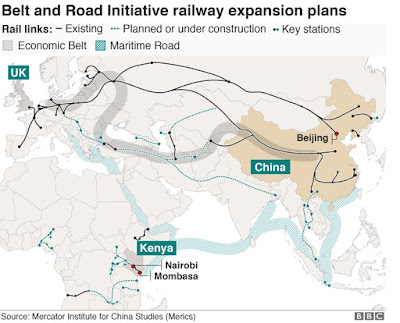
Is China becoming a new global superpower?  A new initiative reminds many of China's role in the ancinet Silk Roads. Today, the Chinese government is spending trillions of dollars building ports and highways over land and along maritime routes in the Indian ocean.  Over land, for example, a railroad line connects China to London and gas pipelines run from the Caspian Sea to China.  The Chinese are also spending billions of dollars building ports in the Indian Ocean. Some of these ports are built in weak countries like Pakistan and Sri Lanka, who cannot repay the cost. Consequently, China got a 99 year lease on the port in Sri Lanka and a 40 year lease on the port in Gwadar, Paksitan. Check out this excellent short clip from Vox and this story from BBC , which includes some excellent maps. The World Economic Forum also has an excellent story. Thanks to Angela Lee for posting the link to this story.

College Board Now Says AP World Will Start in 1200 not 1450

Image
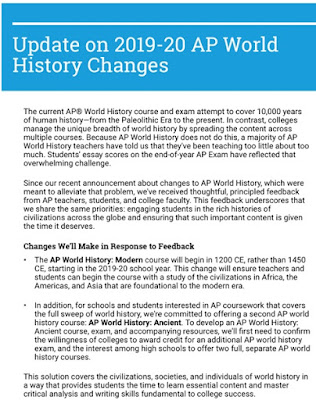
The College Board recently responded to complaints about starting AP World History in 1400 instead of with prehistory, where it has started since the inception of the course. Now, according to the correspondence below, the course will start in 1200 (great, if you love the Mongols, but not so great if you also love the rise and spread of Islam). Many teachers are furious and think the changes do not go far enough. Check out the stories below from Inside Higher Ed and Forbes Magazine and the Twitter response from Amanda DoAmaral. Her exchange with Trevor Packer at an Open Forum duirng the AP World reading in Salt Lake City in June, went viral. Check back. I will try to update the news stories about the new start date of 1200. Inside Higher Ed : Compromising on a Timeline for History Forbes Magazine : The College Board Is Trying To Fix World History But Might Be Making It Worse Education Week : After Outcry, College Board Restores 250 Years to Proposed AP History Course  Politico : ...

The Story and History of Human Rights

Image
How did the United Nations Declaration of Human Rights develop? Facing History and Ourselves produced the video below which decribes Elenor Roosevelt's isntrumental role in its devlopment. And here's an excellent overview of Human Rights from The Youth for Human Rights .