Posts

The Global Nature of WWI: Two Awesome Twitter Threads

The 100th anniversary of the end of World War I has spawned a number of new resources about the war. Two of those resources remind us of the global nature of that war.  Both come from writers on twitter who tweeted the nature of the war in China and Africa I snagged both twitter threads and used a service to embed them below. My thanks to Angela Lee for tweeting both. The first comes from Eileen Cheng-yin Chow, Director of Shewo Institute of Chinese Journalism. Chow notes that although China contributed much to the war effort, including an untold story over 140,000 Chinese laborers who fought on the European frontlines beside French, Russian and British troops,  she got few concessions at Versailles. The thread includes some interesting links including a trailer for a new movie from Yellow Earth Productions called "Forgotten" that is about China during the war. Another link takes you to a fascinating National Post Story about Chinese Labor C...
European Sailors and Navigational Tools in the Age of Encounter and Exchange

Image
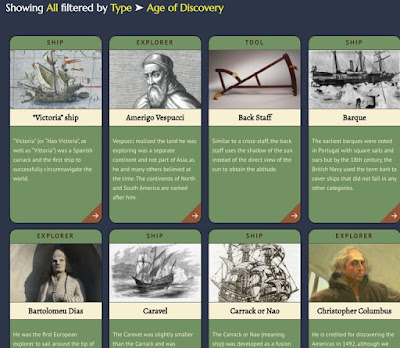
NOTE: I changed the title of this post from "European Explorers and their Tools in the Age of Discovery" to European Sailors and Navigational Tools in the Age of Encounter and Exchange. I did so because of an excellent essay by Bram Hubbell,  an AP World History teacher in New York. Hubbell notes that referring to the period between 1450 and 1750 as the age of discovery is misleading because it "implies that Europeans were the first to reach the Americas." And, notes Hubbell, Da Gamma, Magellan, and other Europeans were not really explorers,  "They were playing catch up & learning about Indian Ocean navigational knowledge that others had known for 1500 years already!" Studying European sailors in the 1500's? Here are two good resources, both of which might work for short web quests. One includes the Mariners Museum lets you explore the instruments of exploration as well the explorers by time period.  During the Age o...

Using Images in AP World History

Image
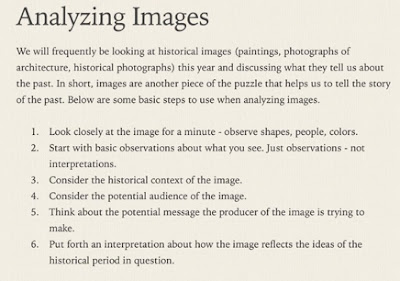
Images offer students a great way to understand history. The AP World History chat recently asked teachers to suggest images they used in their classes.  Here are a few that I snagged. Bram Hubbell tweeted the handout below for analyzing images which ask students to consider the context, audience, and message of each image. The nine images below cover all periods from post-classical to the early 20th century. The image below represents the Danse Macabre, or the Dance of Death, painted in the 16th century during the Black Death. Here's an image from the Song Dyansty scroll which shows society and urban life in Song China. Here is a 1918 image from an Indian Home Rule pamphlet. It shows the British keeping Indians off Wilson's boat of self-determination. The image below from Puck in 1899  shows Japanese perceptions of the West. The image below come s from a Chinese newspaper in China on western colonialism and the response of the Qing court.  ...

Understanding Mercantilism

Image
I'll be covering mercantilism in a couple weeks.  Here are a few resources I found. They include two video clips, an essay from the Economist, and a mercantilism simulation. The first video clip is very short, but a good overview of the basic idea behind mercantilism, more exports than imports. It's only two minutes long and good for class. The second clip comes from Tom Richey and runs 18 minutes. He adds a lot more history and context to mercantilism and ties it to absolutism. Another resource includes an essay in the Economist called, What is Mercantilism .  The author shows how mercantilist themes continue in current debates. For example, he notes that "China and Germany are often envied for their trade surpluses or seen as economic models, and China especially has very deliberately subsidised exports." Finally, here's a simulation students can play. The game includes 11 role-playing cards. Each card has a set of circumstances "that slant “your” perspect...

Ottoman Empire: Excellent Two-Part History Podcast

Image
Studying the Ottoman Empire? 15-minute History, a podcast from the University of Texas at Austin, has a terrific two-part history about the Ottomans. The first part reviews the origins of the empire and the second part considers the empire's long decline and whether the empire was truly the Sick Man of Europe by the 20th century. In addition to listening to the podcast, you can also read the transcript which might be good for students who don't have the patience for listening. The host of 15 Minute History is Christopher Rose, Outreach Director of the Center for Middle Eastern Studies and his guest for the two-part podcast was Barbara Petzen, Director of  Middle East Connections. The podcast includes a link to a primary source collection about the Ottoman Empire from Primary Source.  You can read, for example, about the devshirme system in a short document called " The Tribute of Children, 1493. "

Mughals: Art and Tolerance

Image
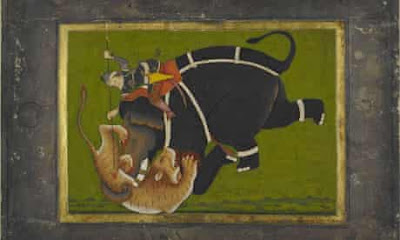
In this 2012 review of Mughal art, William Dalrymple offers a terrific portrait of the Mughal emperors -- Akbar, Humayun, Jahangir, and Shah Jahan. All four promoted and patronized art.  That art was colorful and liberal, at least by Muslim standards. Persians, for example, were scandalized by the art calling it "too ripe and rounded' and "too bright and colorful."  According to Dalrymple, that was because the art did not show the "restraint and geometric perfection of Safavid painting." The Mughal love for art and its emphasis on liberalism shows a strong humanist streak in many Mughal emperors and especially, Akbar. According to Dalrymple,  Akbar "succeeded in uniting Hindus and Muslims in the service of a multi-ethnic, multi-religious state, promoting Hindus in his civil service, marrying Hindu princesses and entrusting his army to the Rajput ruler of Jaipur." Akbar's love for art included religious Christian art like frescoes of Christain...

The Map That Guided Columbus

Image
Wow! The first map below is very likely the one that Columbus used to chart his voyage to Asia.  And the second map shows Europeans what America looked like after the voyage of Columbus and Vespucci. It shows the existence of the Pacific Ocen for the first time. Here's the story about the first map , the one Columbus probably used, from Wired Magazine. And here is a story about the second map , the one that was made after Columbus returned. It's from the Smithsonian Magazine. the first map was made by Henricus Martellus, probably in 1491.